Why banks offshore engineering but not design
US banks already offshore large parts of engineering. The cost case is familiar. The vendor path is familiar. Design rarely follows, even when the cost case looks similar on paper.
That gap is not a mystery about tools. It is a people pattern. If you lead digital at a US bank, you already know the shape of it. This piece names the pattern in plain words. Pair it with the one-pager takeaway PDF when you brief upstairs.
The real block is people, not compliance
Compliance and security get named first. They matter. They are also the easy answer in a committee.
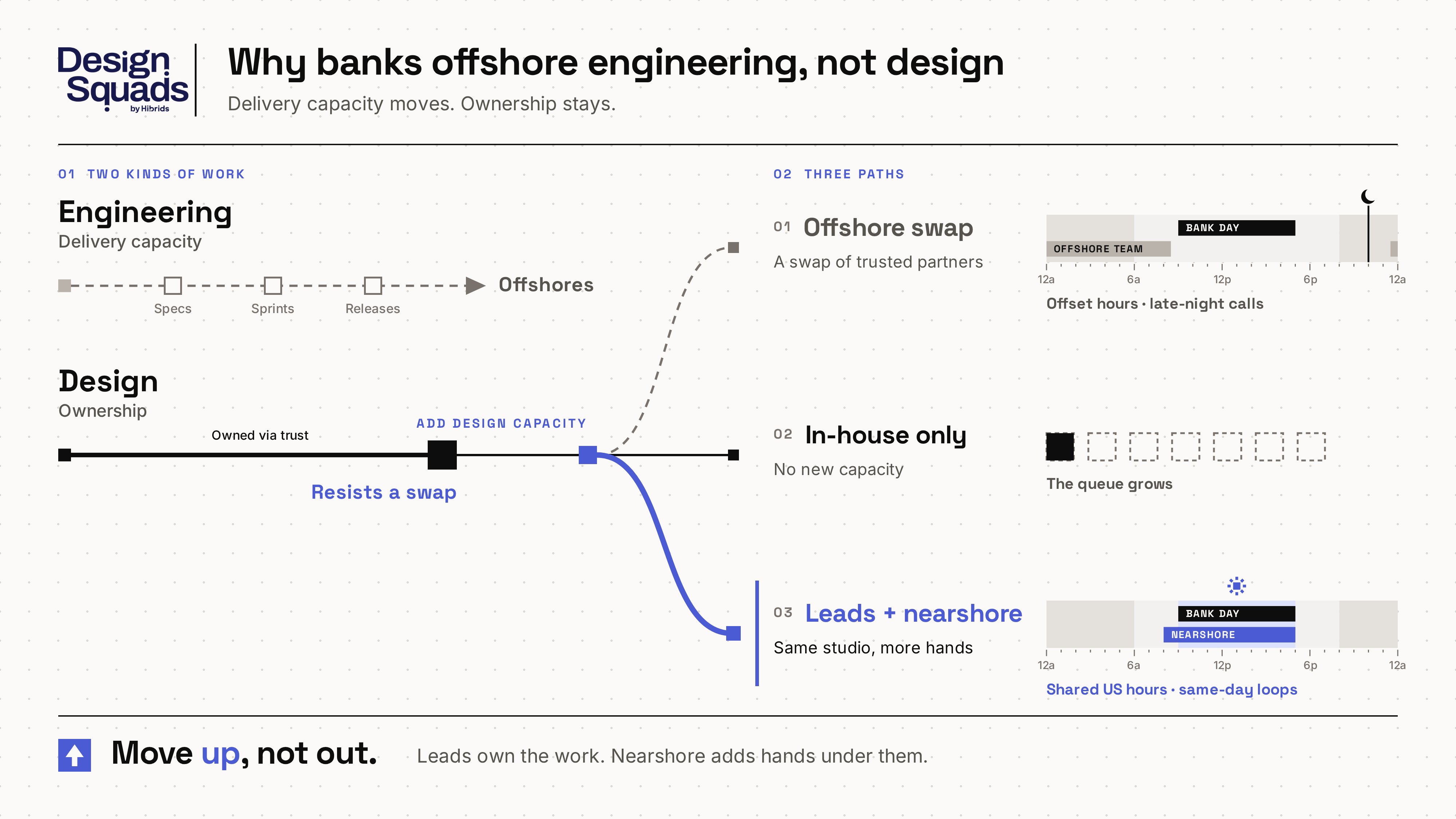
The quieter block is closer to home. Leaders approve offshore engineering because they rarely meet the engineers. The work lands as tickets, releases, and vendor reports. Design sits in a different place. Leaders know their designers by name. Those designers sit in the same product meetings. They present to the same executives. Moving that work offshore feels personal in a way engineering often does not.
There is also an optics risk upstairs. A straight swap of trusted designers for distant cost-cutters reads as cutting people you see every day. That is a bad look for the leaders who have to defend the decision. Capacity under known leads softens that look. Replacement as the opening move does not.
The objection that stops the deal is people, not the policy deck. Keep that frame when you brief upstairs. Argue the people point first. Compliance still has a path. The people point is what stalls the room.
Far-offshore hours tax design harder than engineering
Engineering can often hand work across a long time gap. Tickets move. Reviews land in writing. Design needs live collaboration: critique, tradeoffs, and decisions in the same working day as product and tech.
Far-offshore teams force late-night or early-morning calls when US leads stay in the loop. That tax is worse for West Coast leads. Over months it drains the exact people you need to keep ownership.
Nearshore shared US working hours are the design-shaped answer. The squad sits in overlapping Eastern and Central hours. Your leads stay on normal calendars. The work stays in Slack or Teams and Jira during the bank's day, not as overnight handoffs.
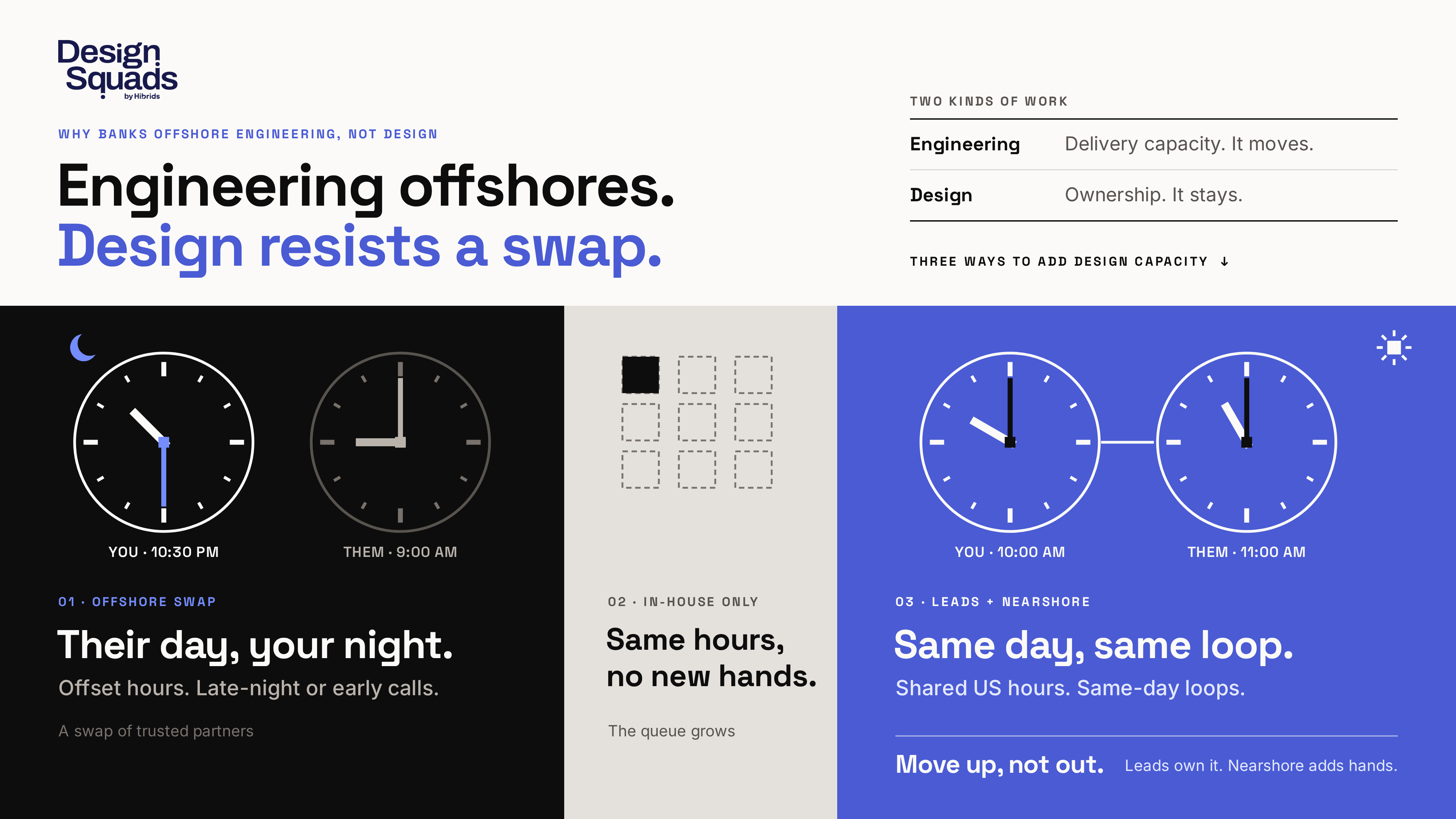
Move people up, not out
The answer is not to cut the designers your leaders trust. The answer is to move those people up.
Keep your in-house designers as product partners. They set priorities. They own tradeoffs. They sign off on what ships. They stay the face of design with the business.
Add nearshore squad capacity underneath them for production load: flows, systems work, iteration, and the queue of screens that pile up behind every roadmap. Frame the model as your own in-house design studio with added capacity. It is not a swap of trusted people for distant ones. It is the same studio, with more hands under the same leads.
Banks already know this path from engineering. Many start far-offshore engineering as capacity extension. Over years, some of those roles slowly replace US seats. Design should not open with that end state. Start as capacity under in-house leads. Prove the pattern. Only then decide whether to grow.
That framing matters upstairs. A Head of Digital who protects named people wins the room. A Head of Digital who seems to replace them loses it.
Keep the practical details simple. The added designers are employees. They work shared US working hours. They work inside the bank's tools and design system. Your senior design leads keep ownership. Start small. Two or three designers as added capacity is enough to prove the pattern without a reorg.
Why design can move faster than other vendor lines
Once the people objection is handled, design often moves on a shorter vendor path than other lines of work.
Design work that uses proprietary but not confidential data often skips the longest tool and security reviews. That does not mean design skips review. It means the path is shorter than the reviews that sit on core systems, payments, or anything that holds customer secrets.
Banks that already use staff augmentation or contractors for digital work usually find this path easier. The model is familiar: added capacity for a defined scope, not a permanent headcount line. Banks that never hire outside design help are harder to open. Start where the bank already buys capacity.
Keep the claim modest. Design does not fix a broken back end. Design does not fix a payments stack. Design does clear product decisions, flows, and interfaces so your tech team has something clean to build from. That is the value of a small pilot: measurable design output your engineers can pick up, not a promise to rewrite the platform.
What to take upstairs
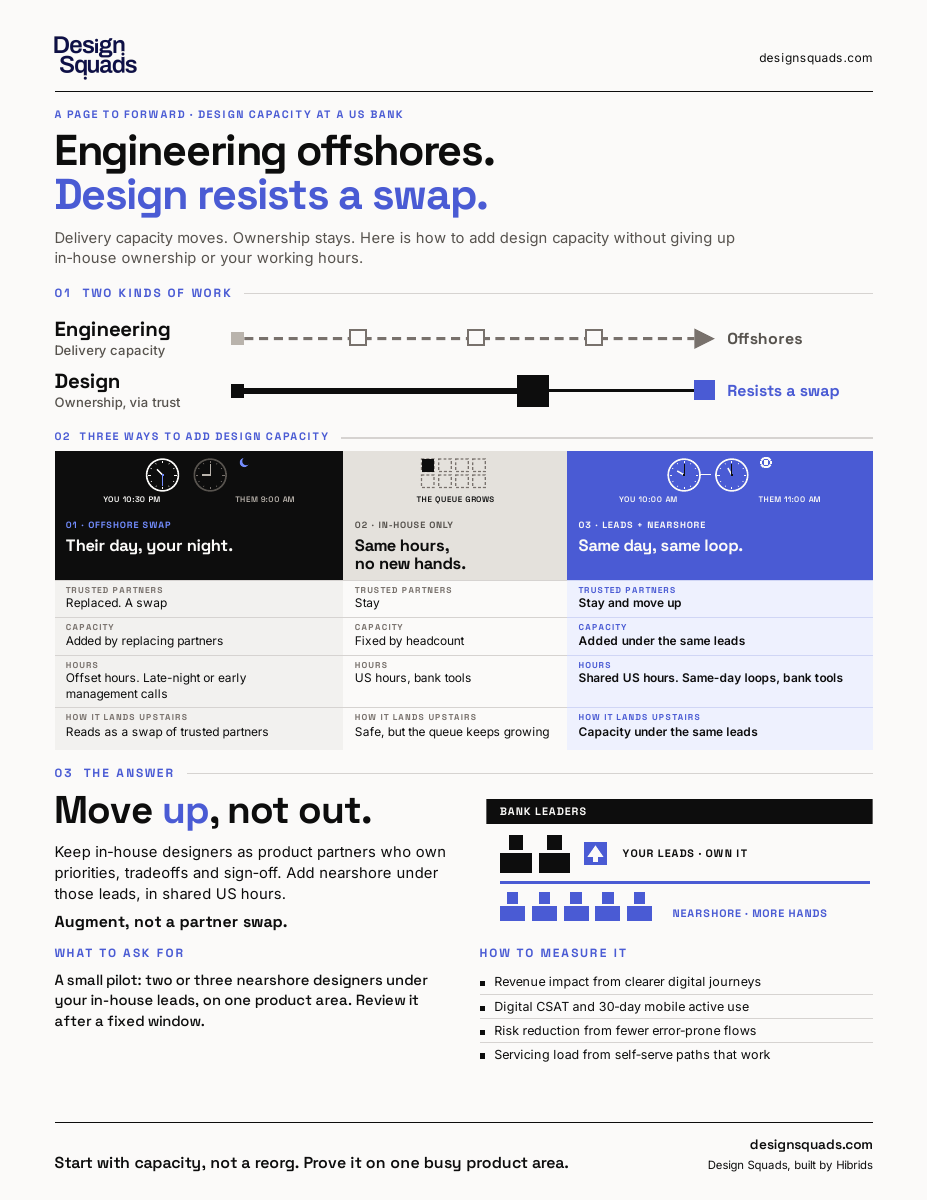
One-page takeaway · PDF
Add capacity under your in-house leads
Forward this when you ask for a small pilot.
This article is the briefing. The one-pager takeaway PDF is what you forward. Attach that PDF when you ask for a small pilot. Do not paste a second wall of bullets into email. Use the FAQ answers below when the room pushes back.
Will this replace our in-house designers?
No. Open as capacity under the leads you already trust. Keep in-house designers as product partners who own priorities and sign-off. Far-offshore engineering often starts the same way: capacity first, and only sometimes slow replacement years later. A straight swap of trusted designers for distant cost-cutters is a bad look upstairs. Do not open with that move.
Why not the same far-offshore model we use for engineering?
Design needs live collaboration in the same working day as product and tech. Far-offshore teams force late-night or early-morning calls when US leads stay in the loop. That tax is worse for West Coast leads. Nearshore shared US hours keep critique and decisions inside the bank's day, in Slack or Teams and Jira, not as overnight handoffs.
What am I actually asking for?
A small pilot on one product area. Two or three designers as added capacity under your in-house leads. The ask is high-quality design output at a fast pace: work your tech team can build from without waiting on a reorg. In-house leads keep ownership of priorities and quality. Review after a fixed window. Grow only after the pattern works.
Who needs to say yes?
The Chief Digital Officer and the product-line heads who own the roadmap usually fund capacity. Head of Design still shapes craft and quality. Brief the people who can approve a pilot budget, not design alone.
Bank cycles are long. Start with capacity, not a reorg.
Bank decisions take time. Other fires pull attention. That is normal. Do not wait for a perfect org chart or a full vendor bake-off across every design role.
Start with two or three designers as added capacity. Keep ownership with your in-house leads. Prove the studio model on one busy product area. Then decide whether to grow.
If you want a peer page for the offer shape, see embedded nearshore design teams for Heads of Digital. If you need a model comparison for finance or HR, see squad vs hiring vs agency.
Design Squads is built by Hibrids for US banks that want that studio model without cutting the people leaders trust. When you are ready for the small pilot, start there.